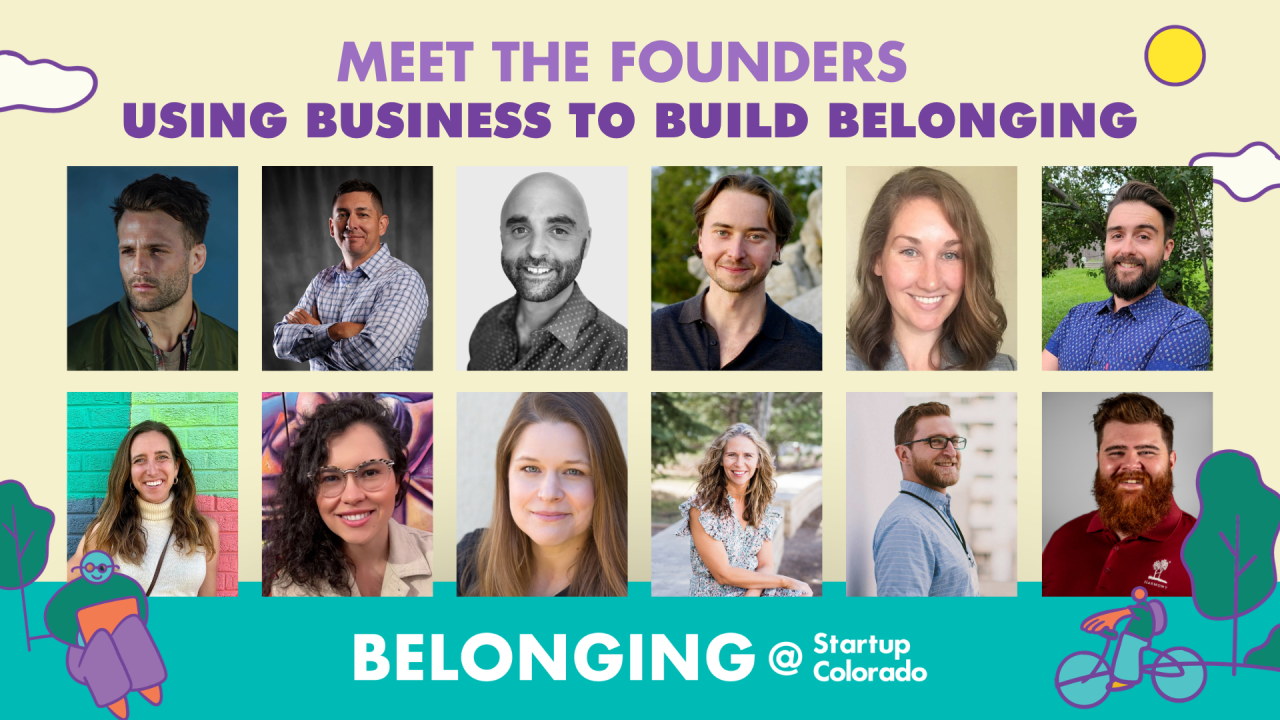
Why Belonging Colorado is investing in entrepreneurs
Most of us don’t think about belonging when we open an app, join an event, or interact with a service. But those moments shape whether we feel connected or alone, included or overlooked.
Increasingly, those experiences are shaped by entrepreneurs—designing the platforms, services, and interactions that influence how we spend our time, who we meet, and whether we feel included or left out.
But of course, most businesses aren’t built with belonging in mind. They prioritize growth, efficiency, and engagement, but not always connection, trust, or the feeling that you matter.
Belonging Colorado is working to change that. Through a partnership with Startup Colorado, Belonging Colorado is funding entrepreneurs to develop new ways businesses help people connect and increase belonging.
Belonging @ Startup Colorado is both an experiment and an investment in what’s possible. By investing in entrepreneurs, we’re asking: What happens when belonging is built in from the start rather than added as an afterthought?
This inaugural cohort of 12 entrepreneurs is the first step in exploring that question.
More than a program or initiative
Belonging entrepreneurship is about more than launching a service or solving a single problem. It’s a broader approach centered on building trust, connection, and shared responsibility within communities, creating the conditions where people feel seen, valued, and invested in one another. These entrepreneurs are building very different types of companies. But they share a common focus: connection.
Because this is the first cohort, what we have today are signals, not outcomes. Early ideas, early models, and a clearer sense of where this work could go.
But even at this early stage, a few exciting themes are emerging.

1. Make connection part of everyday life
Some entrepreneurs are focused on something simple and increasingly rare: everyday connection.
They are building tools that make it easier for neighbors to support one another and for connection to happen in real time.
The goal is to make connection part of daily life, not something people have to seek out.
2. Design for participation—not just consumption
Many systems today treat people as audiences—scrolling, watching, consuming.
These entrepreneurs are designing for participation, creating environments that invite conversation, small-group interaction, and meaningful roles.
Because belonging is built through participation, not passive engagement.
3. Build spaces where connection feels natural
People are more likely to feel they belong when communities create spaces for interaction and participation. From neighborhood gatherings to shared projects and cultural events, everyday experiences help turn strangers into neighbors and neighbors into community.
These ventures are making it easier to find, join, and return to community-led activities.
Because sometimes belonging begins with simply having a place to show up.
4. Build systems of care and visibility
In many systems, people are overlooked—not for lack of care, but lack of visibility.
These entrepreneurs are building tools that surface needs earlier and enable timely, human responses.
Because belonging requires not just connection, but being seen and supported.
5. Bridge across differences
Some entrepreneurs are tackling the challenge of connecting people across differences.
They are creating ways for people to engage across perspectives, identities, and experiences—without requiring sameness.
Because belonging doesn’t come from agreement, but from the ability to connect anyway.
What we hope to learn
In the months ahead, we’ll ask:
- What does it look like to design for belonging in a business?
- What moves people from passive use to active participation?
- What creates not just engagement, but real connection?
There is real momentum. Entrepreneurs are already building toward belonging, even if they haven’t always called it that.
If belonging can be designed into businesses that shape daily life, it expands the ways and places where we build connection. It moves belonging beyond programs and policies into the systems people use every day.
That’s the opportunity in front of us, and it starts here, with this first cohort.
Not just as entrepreneurs, but as people helping define what it means to build belonging on purpose.